

@modelcontextprotocol/inspector, providing three clients behind one binary:
All three are built on the same shared core, so a connection behaves identically across them: the same transports, the same configuration files, the same OAuth state on disk, and the same protocol-era negotiation (legacy vs. modern 2026-07-28).
The package also installs
mcpdo, an experimental connection client that connects to a server once and keeps it open across many commands, on the same core.
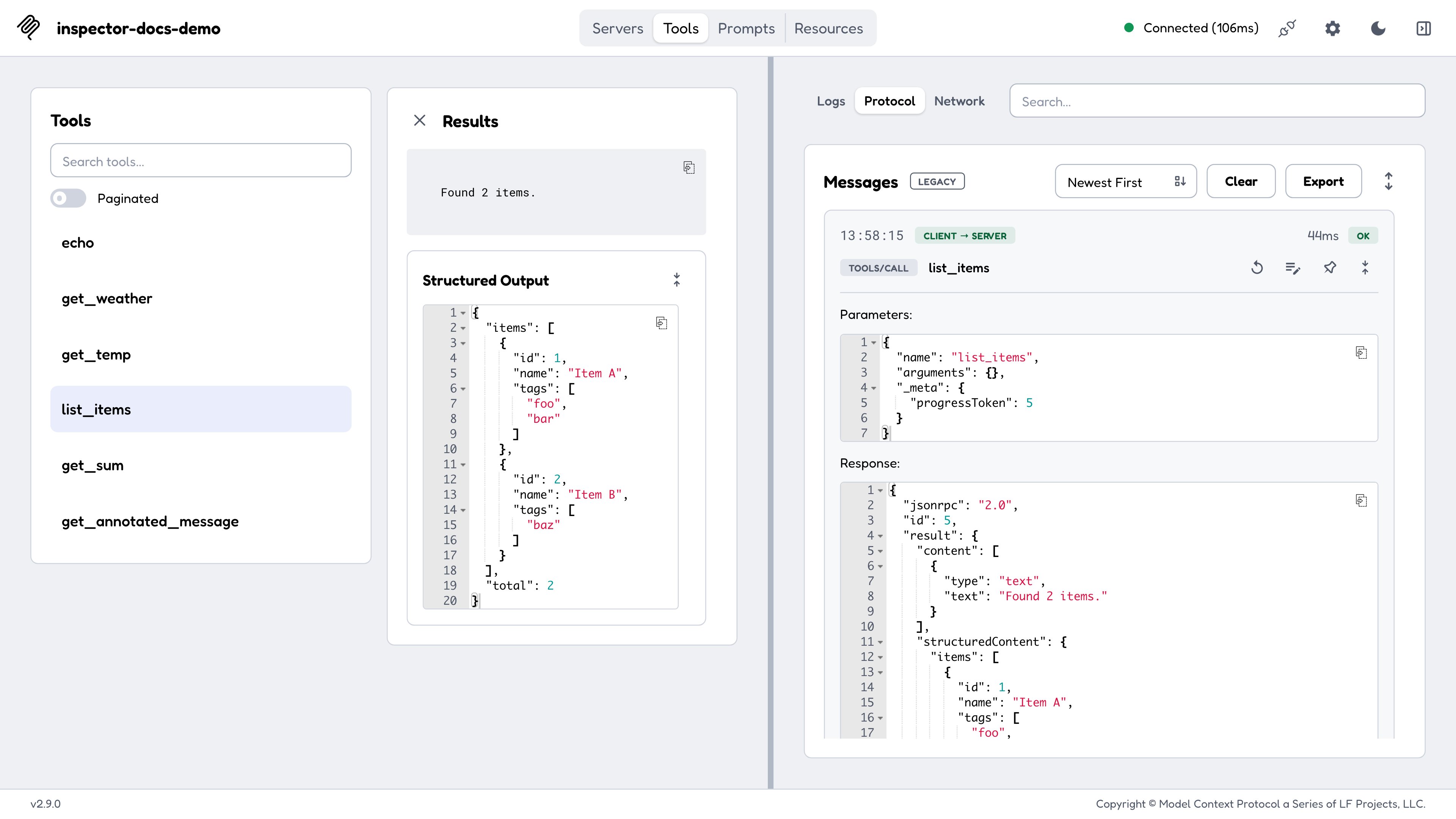
The MCP Inspector web client after a tool call, with the monitoring sidebar pinned and widened so the JSON-RPC exchange stays readable while you work.
Quickstart
The Inspector requires Node 22.19.0 or newer and runs directly throughnpx. No installation is required:
- Web
- CLI
- TUI
MCP_AUTO_OPEN_ENABLED=false to stop it opening). See Web client.Inspecting published servers
Pass the command that launches the server as the Inspector’s arguments, or point it at a remote server with--server-url:
- npm package
- PyPI package
- Remote HTTP server
Launcher flags vs. client flags
mcp-inspector, the binary that npx @modelcontextprotocol/inspector runs, is a thin launcher. It owns only two things:
- The mode flag:
--web(default),--cli, or--tui. At most one; passing two errors withSpecify at most one of --web, --cli, or --tui. -h/--help.
--catalog, --config, --server-url, --transport, --method, the OAuth flags) is defined by the client, not the launcher, and the clients do not all define the same set. The Configuration and flags page is organized that way, by owner.
Mode flags are recognized only at the front of the command line: the first token that isn’t
--web / --cli / --tui ends launcher parsing, and everything after it is forwarded to the client unchanged. That’s what lets a literal --cli appear later as one of your server’s own arguments:--help behaves differently with and without a mode flag. Without one,
-h/--help anywhere on the command line (even after a server command)
prints the launcher’s help and exits. With a mode flag it is forwarded, so
mcp-inspector --cli --help prints the CLI’s full flag reference instead.Where to go next
Web client
A tab-by-tab walkthrough of the graphical inspector.
CLI client
Method reference, output formats, exit codes, and CI recipes.
TUI client
Terminal navigation and keyboard reference.
Configuration and flags
Catalog vs. config files, the full per-client flag reference, and
environment variables.
Authorization
The OAuth flow end to end, mid-session re-authorization, and loopback
callbacks.
Protocol eras
Legacy vs. modern (2026-07-28) operation, and how every tab changes between
protocol eras.
mcpdo connection client
Connect once, then run many commands against a named connection.
Security
The threat model: the web backend’s token, Docker, secret storage, stdio
servers, and the mcpdo daemon.
Recipes
Importing client configs, reviewing MCP Apps, Docker, and network hosting.
Debugging guide
Broader debugging strategies beyond the Inspector.